Therapists: learn more and become a founding member →

How We Verify

Most directories let therapists check boxes and call it a profile. Feel Validated doesn't — every credential has been independently reviewed by a licensed clinician.

The problem we're solving

When you search for a therapist on most directories, you're seeing a list of self-reported claims. A therapist checks "anxiety" and "trauma" and "EMDR" — and you have no way to know whether they completed a weekend workshop or years of supervised training.

That's not a small difference. The depth of a therapist's training in a specific area directly affects the quality of care you receive. You deserve to know what you're getting.

Why profiles end up with 50, 60, even 79 specialties

It's common to find therapist profiles on other directories listing dozens of specialties. This isn't because therapists are being dishonest — it's because the system is designed that way. When a directory gives you an unlimited list of checkboxes and no verification process, the rational response is to check everything you've ever worked with. Experienced therapists with decades of practice have genuinely encountered a wide range of issues. The problem isn't that they checked the boxes — it's that every box looks the same.

A therapist who spent three years in advanced EMDR training and a therapist who attended a single introductory webinar can check the same box. A clinician with deep expertise in couples work earned through years of supervised practice looks identical to someone who took a CE course last month. The checkbox doesn't distinguish between depth and exposure — and that means you can't either.

On Feel Validated, therapists typically have five or six validated specialty areas — not because they're less experienced, but because each one is backed by real evidence. Fewer areas with visible depth tells you more than a long list of unchecked claims ever could.

The pressure to practice outside your training

There's another problem that most clients never see. Some large therapy platforms pressure clinicians to accept clients outside their areas of deepest training — to keep caseloads full and appointment slots booked. The therapist may be skilled and well-intentioned, but the platform's business model rewards volume over fit.

This isn't the therapist's fault. It's a structural incentive created by companies that prioritize filling appointments over matching clients with the right expertise. Feel Validated exists in part to push back on that pressure — by making a therapist's actual depth of training the thing that connects them with clients, not an algorithm optimizing for speed.

When you reach out, you should reach the person you chose

On some platforms, clicking "contact this therapist" doesn't always mean you'll work with that therapist. If they're full, the platform may redirect you to a different clinician — sometimes without making it clear that's what happened. The therapist whose profile caught your eye may never even know you reached out.

On Feel Validated, there is no redirect. When you reach out to a therapist through their profile, you're contacting that person directly. We don't insert ourselves between you and the clinician you chose, and we don't use your inquiry as an opportunity to route you somewhere else. If a therapist is full, they'll tell you — and they can refer you to a colleague they trust, not one an algorithm selected.


Four levels of evidence

Every specialty area on a Feel Validated profile is backed by evidence. We use four levels, each clearly labeled so you can see exactly how a credential was confirmed.

✓ Verified

Confirmed in a public database

We checked a certifying body's searchable directory and confirmed this credential independently. The therapist didn't tell us — we confirmed it ourselves.

Example: "EMDR training verified via EMDRIA therapist directory" — meaning we searched the EMDRIA database and found them listed.
◉ Documented

Supported by submitted evidence

The therapist provided documentation — a certificate of completion, a CE transcript, a training organization letter — and we reviewed it. The evidence is real and specific.

Example: "Gottman Level 2 training, documented via certificate of completion, 2022" — meaning we've seen the certificate.
◎ Reviewed

Assessed by a licensed clinician

A licensed clinician reviewed the therapist's description of their clinical experience in this area — looking for specificity, depth, and clinical fluency. This matters most for areas where formal certification doesn't exist but real expertise does.

Example: "Grief and loss work reviewed — 8 years in hospice setting, ongoing consultation group focused on bereavement" — assessed by our clinical reviewer for depth and specificity.
○ Self-Reported

Pending verification

The therapist has indicated they work in this area, but we haven't yet confirmed it through documentation or review. Self-reported items appear in muted styling and do not count toward validation.

This is an honest label. Other directories would just show this claim with no distinction — here, you can see that it hasn't been confirmed yet.

What the review process looks like

Every therapist who joins Feel Validated goes through a structured onboarding process. Here's what happens before a profile goes live.

1

We research their public presence

Before a therapist even uploads anything, we review their state license board records, directory listings, training organization databases, and professional website. We're looking at what they claim and where we can independently confirm it.

2

They submit documentation

Therapists upload training certificates, CE transcripts, and other evidence of their clinical specializations. This is where most directories stop asking questions — it's where we start.

3

A licensed clinician reviews everything

A licensed clinical social worker reviews the evidence, cross-references it with public records, and assesses narratives for clinical depth and specificity. This is a clinical review, not an automated check.

4

Evidence tags are assigned

Each specialty area on the profile gets labeled with the level of evidence supporting it — Verified, Documented, Reviewed, or Self-Reported. Nothing is hidden. You see exactly what we confirmed and how.

5

The therapist reviews and signs the Practice Pledge

Before going live, every therapist reviews their profile for accuracy and commits to the Feel Validated Practice Pledge — a set of ethical commitments around honesty, scope of practice, and ongoing professional development.


How this compares

Here's the difference between what you see on a typical directory and what you see on Feel Validated.

Typical directories

Therapist self-selects from dozens of checkboxes
No one confirms any of it
All profiles look the same regardless of depth
Contacting a therapist may redirect you to someone else
Platform may pressure therapists to fill slots outside their expertise

Feel Validated

Each specialty backed by specific, visible evidence
Reviewed by a licensed clinician before going live
Depth of training is visible — not hidden behind identical checkboxes
You contact the therapist directly — no redirects, no bait and switch
No pay-for-placement — results based on fit, not fees

Search that actually understands what you're looking for

Some directory search tools return over a hundred results no matter what you type — even nonsense. That's not search. That's a list.

On Feel Validated, search results are based on what you actually described and how it matches each therapist's verified training and experience. If you describe what you're going through, we match you with therapists whose documented expertise is relevant to your situation. If no one on the directory is a strong match for what you need, we'll tell you that — rather than showing you everyone and hoping for the best.
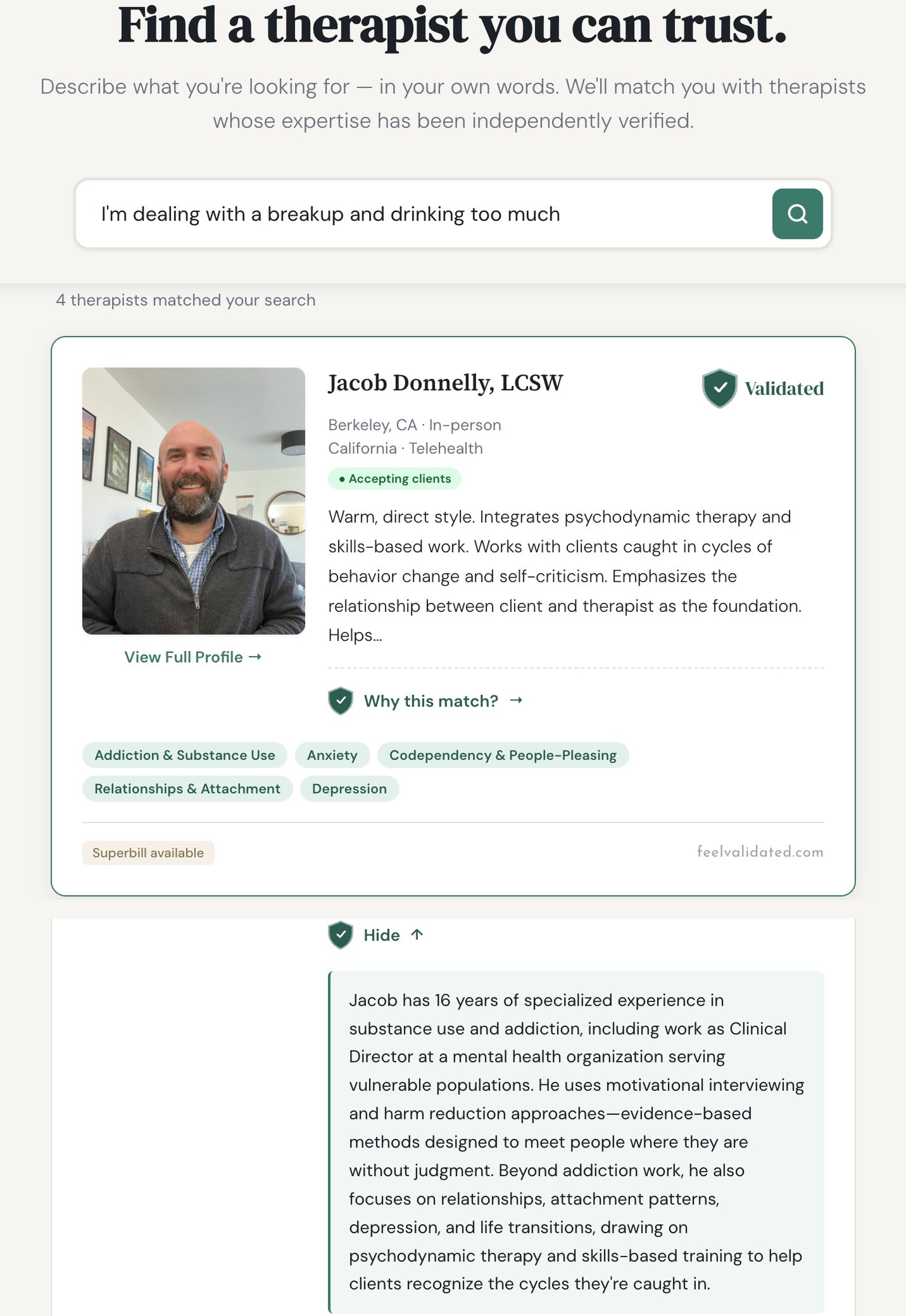
That means fewer results. It also means the results you get are therapists whose training has been reviewed for the specific thing you're looking for — not a list sorted by who paid the most or who updated their profile most recently.


What we don't do

We don't rank therapists against each other. We don't create tiers or levels that imply one clinician is "better" than another. Clinical work is too nuanced for that, and it would be irresponsible to reduce years of specialized training to a leaderboard.

What we do is make evidence visible. A therapist is either validated in a given area — meaning they've cleared a meaningful evidence threshold — or they're not yet. The evidence tags tell you exactly what supports each claim. You get to decide what matters to you.

We also don't accept payment in exchange for higher placement in search results. Every therapist who meets our verification standards gets equal visibility. Your results are based on what you're looking for, not on who paid more.


See it in action

Browse our verified therapist profiles or search for someone who matches what you're looking for.

Search for a therapist → Browse all therapists

Are you a therapist? Learn how Feel Validated can work for your practice →